


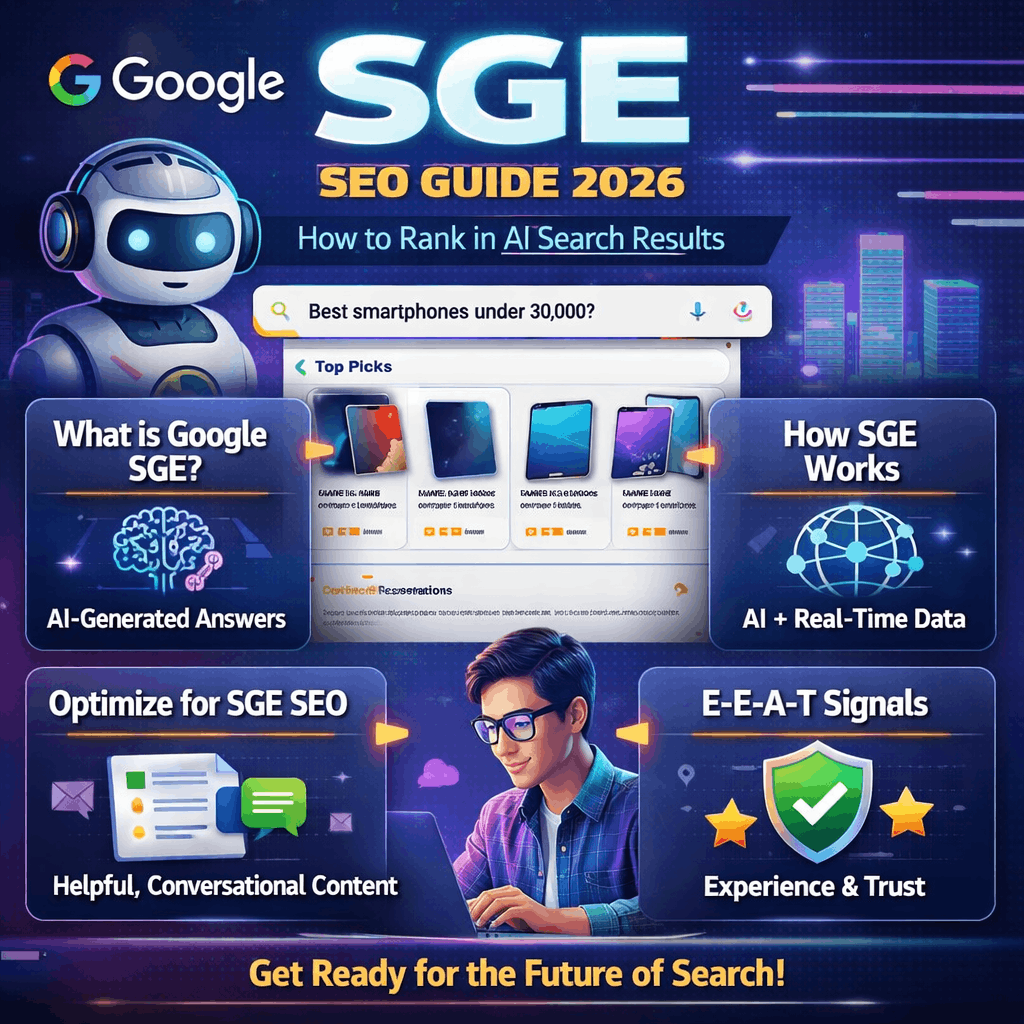
The way users search in 2026 is completely different from how they used to do in the past. Earlier on, users would type their question, browse through different links, and click on different websites to get their answers. However, now the whole process is being transformed into one single intelligent experience fueled by AI.
The heart of this transformation is Google’s Search Generative Experience (SGE), which no longer displays a list of websites to users. Instead, Google now knows what users want and displays a clear answer to their question in an instant.
This transformation is also changing the rules of SEO. Earlier on, getting on the first page was all that mattered. However, now businesses and marketers must get included in the answer created by AI. Those who get to know about this transformation first will get a huge edge over others. Those who still practice traditional SEO techniques may lose the game.
In this guide, we will deeply dive into what SGE is, how it works, and most importantly, how you can optimize your content to get on the first page.
What is Google SGE? (With Example)
The Google SGE, or Search Generative Experience, is an AI-powered tool that provides users with a summarized answer directly on the search engine results page. Instead of visiting different websites to fetch information, Google SGE provides users with a well-structured answer by gathering information from different sources.
With Google SGE, users can get an AI snapshot with a list of smartphones, features, pros and cons, and even buying tips directly on the search engine results page. Along with this, users can also access the original sources provided by Google. However, the focus is completely on AI.
Let’s consider a scenario. Assume that a college student named Aman wants to buy a smartphone before his semester commences. However, he does not have enough time to access 10 different blogs and compare different features. With Google SGE, users can fetch information in seconds directly from Google.
How to Start Using Google SGE (Step-by-Step Guide)
If you want to experience SGE firsthand, here’s how you can enable it:
Step 1: Open Google Search
Go to Google on your browser (Chrome works best).
Step 2: Access Search Labs
Look for the “Search Labs” icon (usually a beaker symbol) on the top-right corner.
Step 3: Enable SGE
Inside Search Labs:
- Find “Search Generative Experience”
- Toggle it ON
Step 4: Start Searching
Now try searching queries like:
- “Best laptops for students”
- “How to start a blog in 2026”
You’ll start seeing AI-generated snapshots at the top.
Device compatibility:
- Works on both mobile and desktop
- Best experience on updated browsers and regions where SGE is fully rolled out
How Google SGE Works in 2026?
In order to be successful in SGE SEO, it is important to understand what happens behind the scenes when a user searches for something on Google.
When a user searches for something on Google, it does not look for keywords anymore. Instead, it attempts to understand the deeper meaning and intent behind the query. The user might be looking for information, might be planning to purchase something, or might be seeking a quick answer or a detailed guide.
Once the intent has been identified, Google’s AI algorithms search through several high-quality sources on the Internet. These sources have been selected on the basis of their relevance, authority, and trust. The AI algorithms then attempt to identify the key insights, combine them, and create a response in real-time.
This real-time response created by Google’s AI algorithms is called the AI snapshot.
One of the most important features of SGE is its contextual understanding. It does not use keywords. Instead, it attempts to understand the relationship between ideas. This is why content written in a natural, simple, and deep manner performs much better than content written using keywords.
Also read: Hyper Local SEO: 7 Proven Strategies to Increase Local Search Visibility
5 Search Generative Experience (SGE) SEO Tips to Rank in 2026
1. Create Helpful Content Based on Actual Experiences
In the age of SGE, the most prominent type of content is that which is created from actual experiences. This is exactly what Google’s AI is programmed to look for.
For example, if you’re writing a blog post about the ‘best SEO tools,’ it is not enough to simply list your opinions. What will work is to tell your readers how you actually went through the experience of using these tools.
2. Topical Authority vs. Keyword Authority
In the older days of SEO, it was enough to get your blog ranked for a single keyword. However, in 2026, Google is looking at the larger picture.
Topical Authority is a relatively newer term that is being thrown around. What it actually means is that instead of writing a single blog post about ‘SEO,’ it is better to create a whole ecosystem of content related to the topic.
If your website has been producing quality content on a particular topic, Google starts to recognize it. Eventually, SGE starts to draw insights from your content regularly, as it trusts your expertise on the subject.
This is how you establish your online presence in AI search engine results.
3. Optimize for Conversational Queries
Nowadays, people are not typing keywords like robots. They are typing like they are having a conversation with someone.
For example, a person may type, “Which is the best phone to buy for gaming under 30k?” or “How to increase my Instagram in 2026?”
If you want to optimize your content to appear in the SGE, your content should look like a conversation with the end user. Instead of forcing keywords, your content should answer real questions in a real manner. The chances of your content being featured in the SGE increase manifold if your content is like a conversation with the end user.
4. Improve Content Structure & Clarity
The most reliable information is not effective if not communicated correctly. SGE prefers content that is easy to read, well-organized, and logically presented. This means that you need to make your content easy to comprehend by using headings, breaking up your content into smaller paragraphs, and using simple explanations. When your content is easy to read, you will find that not only humans but also AI find it easy to comprehend.
For instance, if your article is not well-organized or has no structure, you are likely to find that you are at a disadvantage. On the other hand, if you have well-organized content with proper headings, you will find that you are at an advantage. This is because SGE will easily find the information.
5. Build Trust Signals (E-E-A-T)
Trust is a critical factor that determines your ranking on SGE. This is because Google uses Experience, Expertise, Authority, and Trust to determine the ranking of your content. This is commonly referred to as E-E-A-T.
To be successful on SGE, you need to show that you have expertise. This means that you need to show that you are knowledgeable.
For instance, in domains such as health and finance, the importance of trust is even higher. Therefore, if the content is not considered credible, it would not feature in the AI-generated results.
On the other hand, content that establishes authority and trustworthiness has a much higher chance of featuring in SGE results.
Conclusion
Google SGE is changing the way search functions. It’s no longer about getting to the top; it’s about becoming part of the answer.
As AI gets more advanced, the spotlight would shine even brighter on content that’s helpful to users. Businesses and content creators who get this and adjust their strategies accordingly would be at a significant advantage.
If you want to succeed in 2026 and beyond, start creating content that’s helpful to users. Start creating content that answers their queries and establishes trust. That’s the only way to succeed in the world of AI search. Value would always win over tricks.