


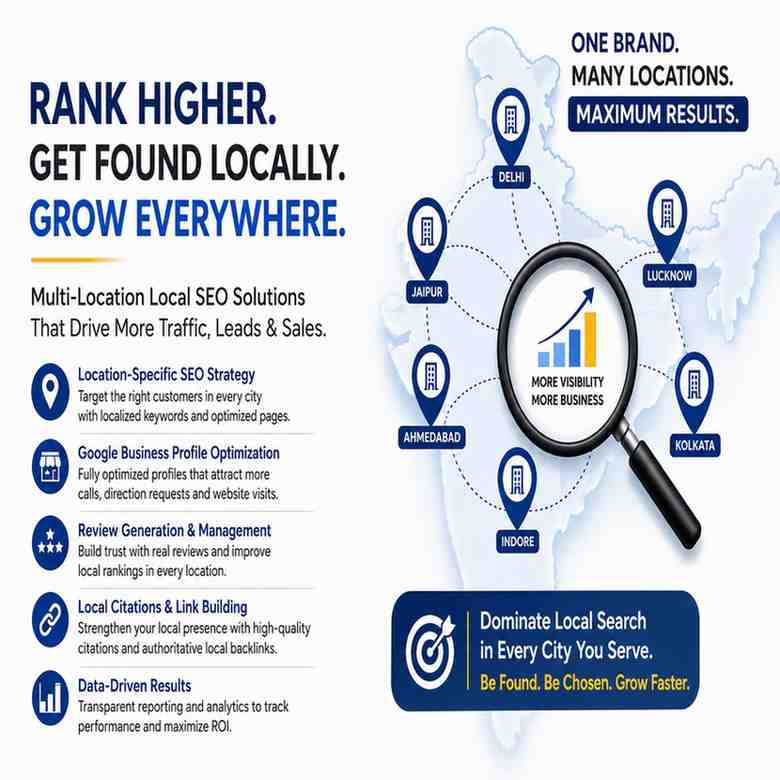
Having multiple business locations should give you an advantage in search results—but in reality, most businesses fail to leverage it.
Why?
Because they assume that one website or one SEO strategy will work for all locations.
But search behavior doesn’t work like that.
When a user searches for a service, Google immediately localizes the results. It prioritizes businesses that are:
- Closest to the user
- Most relevant to the query
- Most trusted in that specific area
This means your Gurgaon branch, Delhi branch, and Noida branch are all competing in different local ecosystems.
If you don’t optimize each one properly, Google simply won’t show you—no matter how strong your overall brand is.
👉 That’s why multi-location SEO is not just marketing—it’s directly tied to your revenue from each city.
Understanding Multi-Location SEO: Beyond the Basics
Multi-location SEO is not just about creating multiple pages—it’s about building individual digital identities for each location.
Think of it this way:
Even though all your branches belong to one brand, Google evaluates them separately based on:
- Local relevance
- Local authority
- Local engagement
For example, if your Gurgaon location has:
- More reviews
- Better local content
- Stronger backlinks
Then it will rank higher than your Delhi location—even if both belong to the same company.
👉 This is why treating all locations equally without customization leads to poor performance.
Creating Location Pages That Actually Rank (Not Just Exist)
One of the biggest mistakes businesses make is creating location pages just for the sake of it.
They usually:
- Copy the same content
- Replace the city name
- Publish it
And expect results.
But Google is smart enough to detect this.
What Google Actually Wants
Google wants each page to provide genuine local value.
That means your location page should answer:
- Why should someone in this city choose you?
- What makes your service relevant here?
- What local problems are you solving?
How to Build a High-Performing Page
A strong location page should naturally include:
- A localized introduction that talks about the city
- Services tailored to that area
- Mentions of nearby locations or landmarks
- Real customer experiences from that branch
When users land on the page, they should feel:
👉 “Yes, this business operates in my area.”
That’s when both rankings and conversions improve.
Keyword Strategy: The Foundation of Local Visibility
Most people think keyword research is just about finding high-volume terms.
But in multi-location SEO, it’s about intent + geography.
Understanding Local Intent
When someone searches:
- “SEO agency in Gurgaon”
- “best digital marketing near me”
They are not browsing—they are looking to take action.
That’s why these keywords have:
- Lower competition (compared to generic keywords)
- Higher conversion rates
How to Structure Keywords Properly
Instead of targeting one broad keyword, you should:
- Assign specific keywords to each location
- Avoid overlap between pages
- Focus on long-tail variations
For example:
- Gurgaon page → “digital marketing agency in Gurgaon”
- Delhi page → “digital marketing company in Delhi”
This ensures:
- Clear targeting
- Better rankings
- No internal competition
Google Business Profile: Your Biggest Lead Source
If your goal is leads, your Google Business Profile (GBP) is more important than your website.
Why?
Because many users:
- Don’t even visit websites
- Directly call from Google
- Check reviews and decide instantly
What Makes a GBP Perform Well
A well-optimized profile doesn’t just exist—it actively attracts users.
This happens when:
- Your information is accurate and complete
- Your images look authentic and engaging
- Your updates show that the business is active
Google also tracks user interaction:
- Clicks
- Calls
- Direction requests
👉 The more engagement your profile gets, the higher it ranks.
The Real Impact
A strong GBP can:
- Generate daily leads
- Increase walk-ins
- Build instant trust
Even if your website is average.
Building Local Authority: Why Backlinks Still Matter
Backlinks are still one of the strongest ranking factors—but for local SEO, relevance matters more than quantity.
What “Local Authority” Means
Google wants proof that your business is trusted in a specific area.
This proof comes from:
- Mentions on local websites
- Listings in local directories
- Partnerships with nearby businesses
Why Generic Links Don’t Work as Well
If you only build general backlinks, Google sees you as a broad entity—not a local one.
But when you get links from:
- City-based blogs
- Local news sites
- Community platforms
👉 It strengthens your presence in that specific location.
Reviews: The Trust Factor That Also Ranks You
Reviews are where SEO and user psychology meet.
Before choosing a business, users always check:
- Ratings
- Number of reviews
- Recent feedback
Google does the same.
How Reviews Influence Rankings
Google considers:
- How many reviews you have
- How often you get them
- How positive they are
A location with:
- 100+ recent reviews
will always outperform one with: - 10 old reviews
How Reviews Influence Conversions
Even if you rank #1, users won’t choose you if:
- Your rating is low
- Your reviews look outdated
👉 Reviews don’t just bring traffic—they convert it.
Technical SEO: The Silent Backbone
Most people ignore technical SEO in local strategies—but it plays a critical role.
Why It Matters
Even if your content is strong, poor technical setup can:
- Prevent pages from indexing
- Slow down your website
- Hurt mobile experience
Key Areas to Focus On
A well-structured multi-location site should:
- Have clean URLs (organized by location)
- Load quickly on all devices
- Be mobile-friendly
- Use structured data (schema)
This helps search engines:
- Understand your site
- Index it correctly
- Rank it efficiently
Content Strategy: Scaling Your Presence Across Cities
Content is what allows you to expand beyond just service pages.
Instead of relying only on location pages, you should create supporting content.
Why This Works
When you publish content like:
- “Best services in Gurgaon”
- “How to choose a company in Delhi”
You:
- Capture more search queries
- Build authority in that region
- Bring in additional traffic
The Compounding Effect
Over time:
- More content → more visibility
- More visibility → more clicks
- More clicks → better rankings
👉 This creates a long-term growth loop.
The Business Impact: Turning Rankings into Revenue
Let’s connect everything to results.
When your multi-location SEO is properly executed:
You don’t just:
- Rank higher
You actually:
- Get more calls
- Generate more inquiries
- Increase store visits
Why This Traffic Converts Better
Local SEO traffic is:
- Highly targeted
- Location-specific
- Action-driven
These users are not researching—they are ready to choose.
👉 That’s why local SEO delivers better ROI compared to general SEO.
Why Businesses Choose I Create Brand
When it comes to digital marketing, results matter.
I Create Brand is focused on delivering:
- Data-driven SEO strategies
- Local lead generation
- Multi-location visibility
- Scalable marketing solutions
Instead of using generic methods, the approach is:
✔ Customized for your business
✔ Focused on ROI
✔ Built for long-term growth
Conclusion: From Visibility to Dominance
Multi-location SEO is not about doing more work—it’s about doing smarter, localized work.
If you:
- Treat each location as unique
- Build authority in each area
- Focus on user intent
Then your business doesn’t just appear in search results—it dominates them.