
Every few months, Google reshuffles the deck. But the Google Algorithm Update April 2026 isn’t a minor reshuffle — it’s a full table flip for sites that relied on shortcuts. If your organic traffic took a sudden hit this month, you’re not imagining it. This core ranking update has already triggered major search engine ranking fluctuations across industries, and websites in niches like health, finance, law, and e-commerce are feeling the heaviest pressure.
In this guide, you’ll get a clear breakdown of what changed, why it matters, and — most importantly — a step-by-step recovery roadmap you can act on today.
What Is the Google Algorithm Update April 2026?
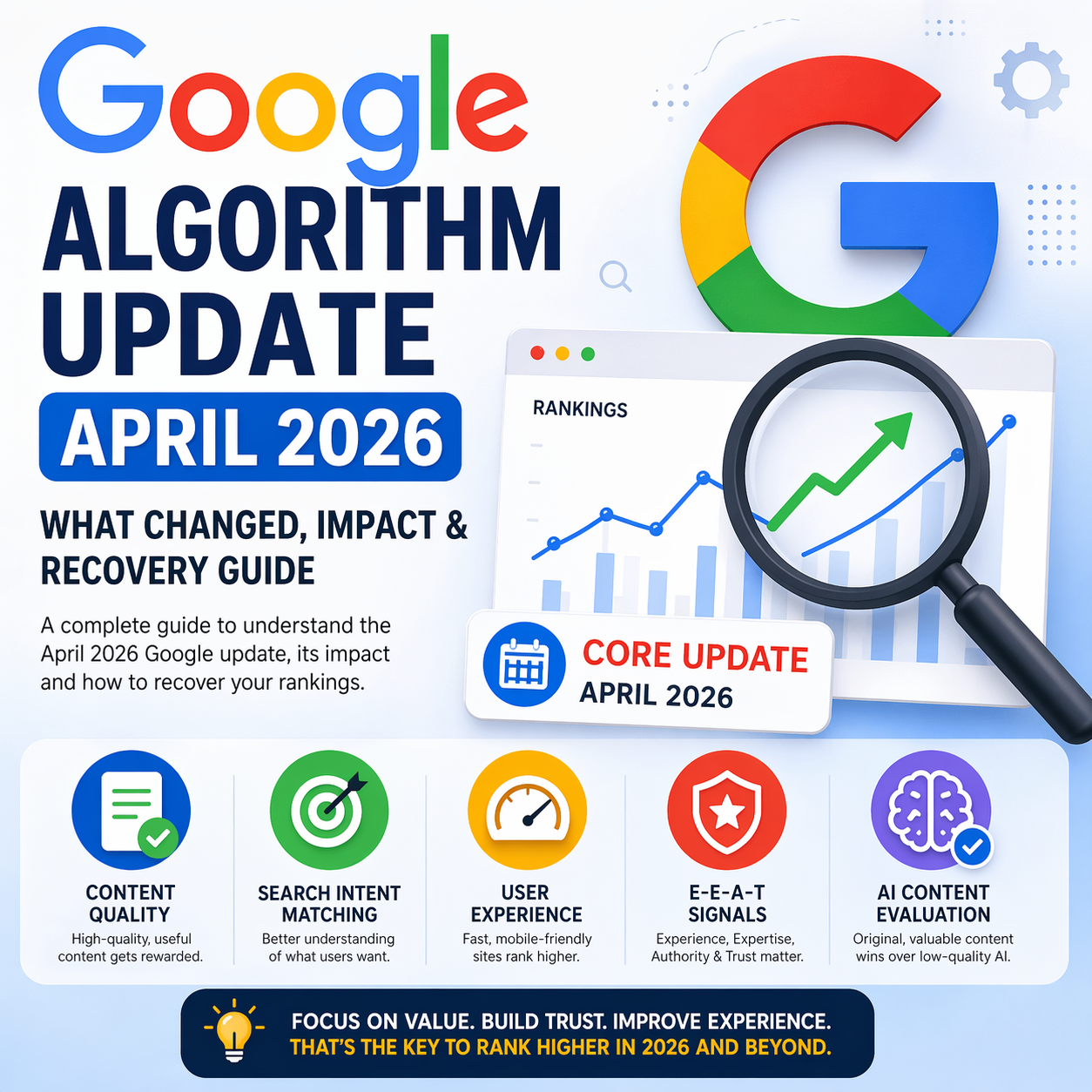
The Google Algorithm Update April 2026 is classified as a broad core update — the kind that doesn’t zero in on one spam tactic or a single technical flaw. Instead, it adjusts how Google’s entire search ranking system evaluates and rewards content at scale.
Google core updates happen several times a year. Most are minor adjustments. But this one is significant. It introduces a stronger weighting on search intent alignment, topical authority, and real-world expertise signals — all under Google’s expanded E-E-A-T (Experience, Expertise, Authoritativeness, Trustworthiness) framework.
The practical result? Pages that were coasting on keyword density, thin coverage, or bulk AI-generated content have dropped — fast. Meanwhile, sites with genuine depth and credibility are holding or gaining ground.
Key Changes in the April 2026 Core Update
Understanding what Google actually changed helps you fix the right problems instead of chasing the wrong ones. Here’s what the April 2026 Google search update focuses on:
1. Stronger Topical Authority Signals
Google’s search algorithm now places significantly more value on niche expertise. A website that consistently covers a topic from multiple angles — with original insight, data, and structured content clusters — outperforms broader sites that treat topics superficially. This is a direct outcome of the Topic Authority System Google introduced in 2023, now running at full strength.
2. Deeper E-E-A-T Evaluation
The Google ranking factors around E-E-A-T have been tightened. First-hand experience, verifiable author credentials, and original data are no longer nice-to-haves — they’re expected. Pages that lack a real author, rely entirely on scraped or regurgitated content, or offer no unique perspective are being scored down across SERP ranking changes.
3. Scaled AI Content Faces Heavier Scrutiny
Bulk AI-generated content with no human oversight is being actively devalued. Google’s systems have become better at detecting templated, low-signal content — even when it’s grammatically correct and keyword-stuffed. Helpful content guidelines now reward content that demonstrates genuine thought, not just plausible-sounding prose.
4. Core Web Vitals and Mobile UX Carry More Weight
The page experience update signals introduced in 2021 haven’t gone away — they’ve compounded. INP (Interaction to Next Paint), LCP (Largest Contentful Paint), and CLS (Cumulative Layout Shift) scores are now more directly tied to ranking outcomes. Slow-loading or visually unstable pages on mobile are losing ground in organic search visibility even when the content itself is strong.
5. Local and Contextual Relevance Refined
Google has sharpened its ability to interpret local search ranking factors and user context. The same query can now return noticeably different results based on geographic signals, device type, and user search history patterns. If your content lacks geographic or contextual specificity where it’s needed, your visibility may shrink.
Also read: Google My Business Update April 2026
How the April 2026 Update Is Affecting Rankings
The search engine ranking fluctuations triggered by this update have been sharp and fast. Within 72 hours of rollout, multiple tracking tools reported volatility scores above 9/10 — nearly as high as the March 2024 Core Update, which took 45 days to fully settle.
YMYL websites (Your Money or Your Life) — covering health, personal finance, legal advice, and medical topics — took the hardest hits. These industries face the strictest Google quality rater guidelines evaluation, and any gap in E-E-A-T signals becomes a liability quickly.
Sites showing the biggest drops share common traits: thin content relevance signals, no clear author authority, weak internal linking structures, and heavy reliance on AI-written content without editorial review.
Sites that held steady or gained? Consistent topical focus, real expert contributors, well-structured semantic SEO markup, and clean technical foundations.
Impact on Content Quality and Organic Search Visibility
This update puts content quality assessment at the center of everything. Google’s systems are now better than ever at distinguishing content that genuinely serves a user from content that merely appears to.
Three critical shifts in how Google search ranking algorithm evaluates content quality right now:
Depth over density. Word count alone never mattered much, but now Google actively rewards content that goes further — covering subtopics, answering follow-up questions, and providing context that less thorough pages skip.
Freshness with purpose. Updating a page just to change the date won’t help. The website ranking update rewards freshness when it adds real, new information — not when it’s cosmetic.
Intent-first structure. A page targeting a keyword without truly satisfying the reason someone searched for it will underperform. Search intent alignment — matching what you publish to why someone is searching — is now one of the clearest Google ranking factors in play.
Mobile Experience and Page Performance
If you’ve been deprioritizing mobile optimization, the Google Algorithm Update April 2026 is your wake-up call. Mobile-first indexing has been default for years — but this update raises the bar on what “mobile-friendly” actually means.
Core Web Vitals improvement is no longer optional for competitive rankings. Here’s what to prioritize:
- LCP under 2.5 seconds — your main content must load fast on a 4G connection
- INP under 200ms — pages need to respond instantly when a user taps or clicks
- CLS under 0.1 — no shifting layouts that frustrate mobile users mid-read
These aren’t just technical metrics. They directly shape user experience ranking signals, and Google is now using them as a meaningful differentiator between pages of similar content quality.
Step-by-Step Recovery Guide
If the Google Algorithm Update April 2026 knocked your rankings, here’s your recovery plan — in order of priority:
Step 1 — Audit for E-E-A-T gaps Pull your top 20 pages by previous traffic. For each one: Does it show first-hand experience? Is there a real, credentialed author? Does it cite original data or primary sources? Flag everything that falls short.
Step 2 — Fix content depth and topical gaps Use a topic cluster map to identify where your coverage is thin. Add original analysis, expert quotes, case studies, and structured FAQ sections. Strong on-page SEO optimization means answering not just the main question but the questions around it.
Step 3 — Address Core Web Vitals Run your site through Google’s PageSpeed Insights and fix the highest-impact issues first. Image optimization, lazy loading, and server response time are the most common culprits behind poor website ranking update performance.
Step 4 — Rebuild internal linking around topic clusters Map your content by theme and strengthen internal links between related pieces. This signals topical authority to Google’s crawlers and distributes link equity more effectively across your site.
Step 5 — Set up consistent performance monitoring Weekly tracking — not monthly — is the minimum after a major Google search ranking update. Use Google Search Console for impression and click data. Track page-level changes, not just site-wide averages. Early data is the difference between a fast recovery and a slow bleed.
Final Thoughts
The Google Algorithm Update April 2026 didn’t change what good SEO looks like — it raised the stakes for doing it right. Real expertise, genuine depth, fast mobile performance, and content that actually serves search intent have always mattered. Now they’re the price of admission.
Sites that built on shortcuts are paying for it now. Sites that built on substance are being rewarded.
Start your audit today. The longer you wait, the further behind the recovery curve you fall.