

The internet was built for everyone. But for years, millions of users with disabilities have been quietly left behind unable to read low-contrast text, navigate without a mouse, or understand images without descriptions. In 2026, that story is finally changing.
Web accessibility in 2026 is no longer a “nice to have” feature tucked into a developer’s checklist. It has become a core pillar of digital strategy : one that directly impacts your SEO rankings, your brand credibility, and the trust users place in your website. Businesses that ignore it are not just losing visitors; they are losing ground in search engine results and, in many countries, risking legal consequences.
This blog breaks down what web accessibility means today, why it matters more than ever for your SEO, and what practical steps you can take to make your website truly open to all.
What Is Web Accessibility in 2026?
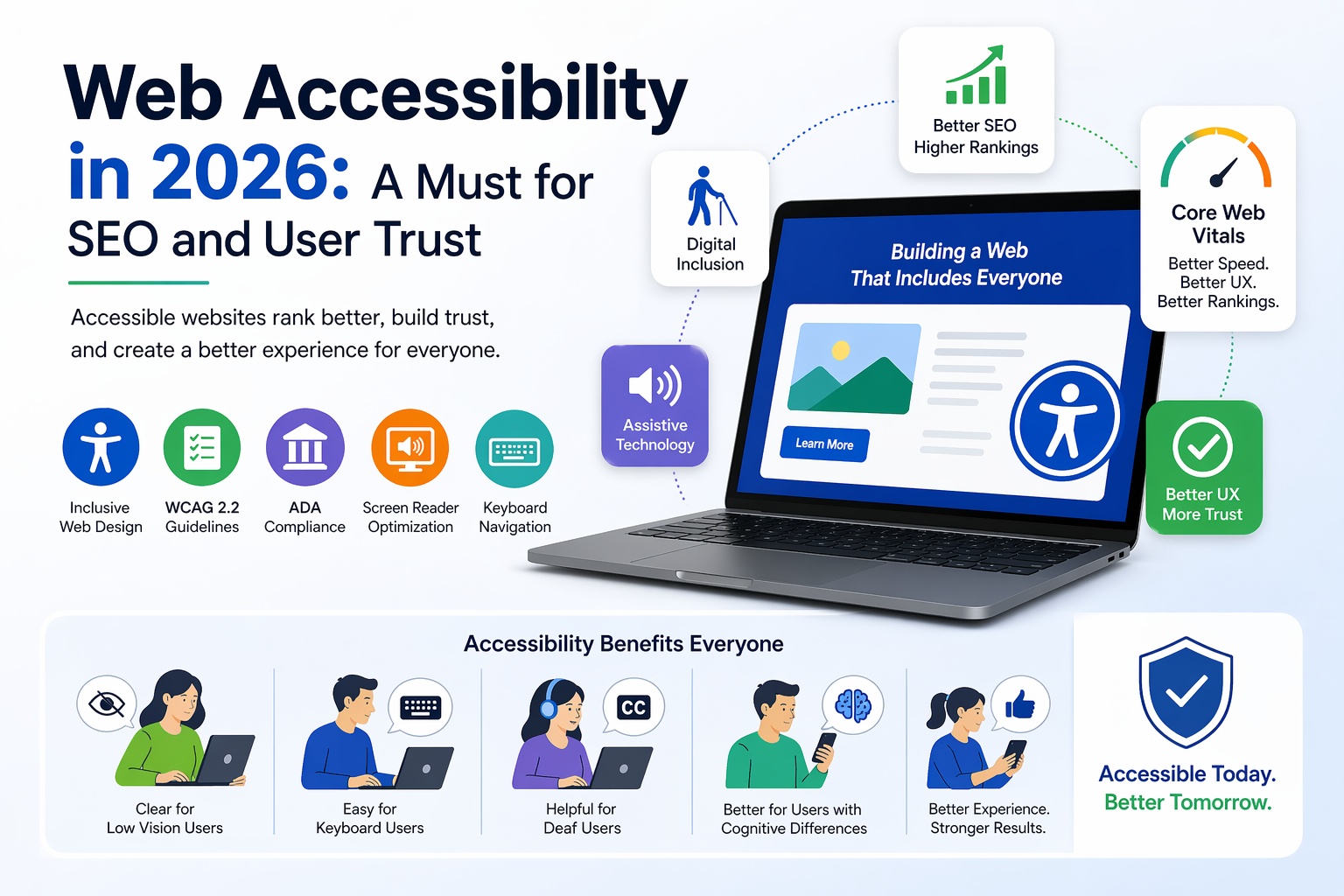
Web accessibility refers to the practice of designing and developing websites so that people of all abilities can use them without barriers. This includes users with visual impairments, hearing disabilities, motor limitations, and cognitive differences.
In 2026, accessibility standards have become a central part of how successful digital marketing strategies are built. The guidelines that govern web accessibility today define four core principles that shape how users experience a brand online — whether they can see your content clearly, navigate your pages without frustration, understand what you are offering, and trust that your website works reliably on every device they use.
Practically, an accessible website in 2026 means:
- Every image has descriptive alt text that a screen reader can announce
- Buttons and links can be accessed through keyboard navigation alone
- Color contrast ratios meet minimum standards for readability
- Videos include captions and transcripts
- Forms clearly indicate errors and guide users through corrections
- Pages are structured with logical heading hierarchies (H1, H2, H3)
When these elements are in place, both users and search engine crawlers benefit. Accessibility is no longer about compliance alone :it is about quality, and quality is something Google rewards.
Also read: Google Algorithm Update April 2026
Why Web Accessibility Should Be a Core Part of Your SEO Strategy
Here is the truth that many businesses miss: accessibility and SEO share the same foundation. Both exist to make content easier to understand and navigate. When you build for accessibility, you are simultaneously building for better search performance.
Let’s look at the direct connections:
1. Alt Text and Image SEO Alt text was originally designed to help visually impaired users understand image content. But it also tells Google what your images are about. A website with proper alt descriptions on every image ranks better in Google Image Search and gives crawlers richer context about the entire page.
2. Heading Structure and Topic Relevance Proper use of H1, H2, and H3 tags helps screen reader users navigate pages without scrolling through everything. For SEO, these same headings tell Google the hierarchy of your content and which keywords matter most. Skipping heading levels or using them randomly weakens both accessibility and on-page optimization.
3. Core Web Vitals and Digital Inclusion Google’s Core Web Vitals :which measure loading speed, interactivity, and visual stability : align closely with accessibility goals. A page that loads fast and behaves predictably is easier for everyone, including users on assistive technology or slower mobile connections. Accessibility naturally strengthens these metrics because faster pages are easier to access, clear layouts reduce confusion, and proper coding avoids layout shifts that disrupt readers.
4. Bounce Rate and Dwell Time When users with or without disabilities find a website confusing, cluttered, or unusable, they leave. Search engines read that behavior as a negative signal. An accessible website keeps visitors comfortable and engaged longer, which improves dwell time and reduces bounce rate two behavioral signals that quietly influence where you appear in search results.
5. Mobile Accessibility India has one of the highest mobile internet usage rates in the world. If a site isn’t mobile-friendly, accessibility problems multiply small buttons, overlapping menus, and missing text breaks make browsing painful. A mobile-accessible design signals to Google that your site respects the user experience across all devices.
The Trust Factor: Why Accessible Websites Build Stronger Brands
SEO rankings get users to your door. Trust is what makes them stay and come back.
When a website is built with accessibility in mind, users notice, even if they cannot articulate why. Clean navigation, readable fonts, clear calls to action, and logical page flow all create a sense of care and professionalism. That emotional response builds brand credibility in a way that no keyword strategy alone can replicate.
Studies consistently show that users who encounter friction on a website :
broken navigation, unreadable text, videos without captions associate that frustration with the brand itself. An inaccessible website communicates carelessness. An accessible one communicates that you respect every visitor who arrives at your door.
For businesses in competitive markets, that difference in perception can directly influence conversion rates, customer retention, and word-of-mouth reputation.
How I Create Brand Helps You Build an Accessible, High-Ranking Website
Understanding web accessibility in 2026 is one thing — actually implementing it across your website is another. That is where I Create Brand steps in.
I Create Brand is a full-service digital marketing agency that combines deep SEO expertise with technical website auditing to help businesses build websites that are both search-engine-friendly and fully accessible to every user. Whether you are a startup building your first website or an established brand looking to fix hidden accessibility gaps, the I Create Brand team brings the right strategy and execution to the table.
Simple Steps to Make Your Website More Accessible Today
You do not need to overhaul your entire site overnight. Start with these high-impact changes:
- Add descriptive alt text to every image on your site
- Structure your content with proper H1 → H2 → H3 heading order
- Ensure strong color contrast between text and background (minimum 4.5:1 ratio)
- Enable full keyboard navigation across all pages and forms
- Add captions to every video
- Label all form fields clearly and provide helpful error messages
- Test your website with a free tool like Google Lighthouse or WAVE
After handling the basics, a professional accessibility audit will uncover deeper technical issues : unlabeled links, missing ARIA landmarks, or forms that don’t communicate errors to screen readers. Fixing these puts you ahead of most competitors.
Final Thoughts
Web accessibility in 2026 is not a checkbox. It is a competitive advantage. It is how you signal to Google and to every real human who visits your site that you have built something thoughtful, professional, and worth trusting.
The overlap between inclusive web design, strong Core Web Vitals, and search engine optimization is no coincidence. They all point in the same direction: toward a better experience for every user. Businesses that embrace this now will not just rank better they will be remembered better.
If your website is not yet accessible, the best time to start was yesterday. The second best time is today.