

The way people search online is undergoing a fundamental transformation.
For over two decades, traditional Search Engine Optimization (SEO) has been the foundation of digital visibility. Businesses optimized websites, targeted keywords, and competed for top positions on search engine result pages (SERPs). However, in 2026, search behavior has evolved beyond clicking links.
Today, users expect instant, accurate answers—often without visiting a website. AI-powered systems like Google’s AI Overviews and conversational tools are reshaping how information is delivered. This shift has introduced a new discipline: Answer Engine Optimization (AEO).
Understanding SEO vs AEO in 2026 is critical for businesses, marketers, and content creators who want to remain competitive in an AI-driven search ecosystem.
What is SEO? (Search Engine Optimization)
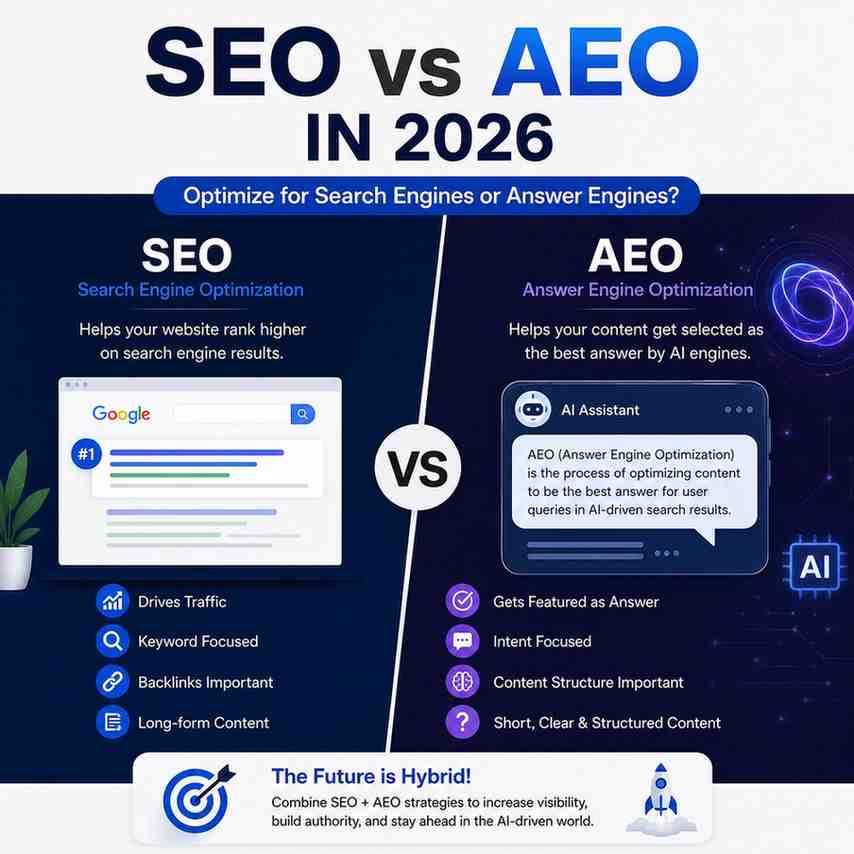
SEO refers to the practice of optimizing digital content to improve its visibility in search engines like Google.
Core Objectives of SEO:
- Rank higher for targeted keywords
- Increase organic website traffic
- Improve website authority and trust
- Generate leads and conversions
Key Components of SEO:
- On-Page SEO – Content optimization, keyword placement, meta tags
- Technical SEO – Site speed, indexing, crawlability, mobile optimization
- Off-Page SEO – Backlinks, brand mentions, authority signals
- Content Strategy – Long-form blogs, landing pages, topic clusters
SEO focuses on bringing users to your website by ranking content for search queries.
What is AEO? (Answer Engine Optimization)
Answer Engine Optimization (AEO) is the process of structuring and optimizing content so it can be directly used as answers by AI systems, voice assistants, and search engines.
Unlike SEO, AEO does not rely solely on clicks. Instead, it prioritizes visibility within answers.
Core Objectives of AEO:
- Provide precise, structured answers
- Get featured in AI-generated responses
- Appear in featured snippets and voice search
- Build authority as a trusted information source
Where AEO Appears:
- AI-generated summaries
- Featured snippets (Position Zero)
- Voice search responses
- Chat-based AI tools
AEO focuses on delivering answers to users without requiring them to visit your site.
SEO vs AEO in 2026: Key Differences Explained
Understanding the distinction between these two is essential for modern digital strategy.
| Aspect | SEO | AEO |
|---|---|---|
| Primary Goal | Drive traffic | Provide direct answers |
| Platform | Search engines | AI systems & answer engines |
| Content Format | Detailed, long-form | Concise, structured |
| Optimization Style | Keywords & backlinks | Context, intent & clarity |
| User Journey | Click → Website | Question → Instant answer |
| Success Metric | Rankings & CTR | Answer visibility & citations |
Don’t miss: Google Algorithm Update April 2026
How to Rank in AI Search: Advanced AEO Strategy
To win in the era of SEO vs AEO in 2026, you need to move beyond traditional optimization and adopt an AI-first content strategy.
1. Prioritize Answer-First Content
Start each section with a clear and direct answer before expanding into details.
Best Practice:
- Define the topic in 1–2 sentences
- Use simple, precise language
- Avoid unnecessary introductions
This increases your chances of being selected for:
- Featured snippets
- AI summaries
- Voice search responses
2. Use Question-Based Headings
Structure your content around real user queries.
Examples:
- What is Answer Engine Optimization?
- Why is AEO important in 2026?
- How does AI search work?
Why It Works:
- Matches user search intent
- Aligns with AI query processing
- Improves snippet eligibility
3. Optimize for Featured Snippets
AI systems prefer content that is easy to extract and summarize.
Use formats like:
- Bullet points
- Numbered lists
- Comparison tables
Well-structured content increases the probability of being featured as a direct answer.
4. Implement Structured Data (Schema Markup)
Schema markup provides machine-readable context to your content.
Important Schema Types:
- FAQ Schema
- Article Schema
- How-To Schema
Benefits:
- Improves content understanding for search engines
- Enhances visibility in rich results
- Increases chances of AI selection
5. Build Topical Authority
AI prioritizes sources that demonstrate deep expertise in a subject area.
Strategy:
Create a content cluster around:
- SEO fundamentals
- AEO strategies
- AI search trends
- Case studies and examples
The more comprehensive your coverage, the higher your authority.
Conclusion
The shift highlighted in SEO vs AEO in 2026 is not just an upgrade in strategy—it’s a complete transformation in how search works and how users consume information.
Traditional SEO is no longer enough on its own. While it continues to play a critical role in driving visibility and traffic, the rise of AI-driven search has changed the end goal. Today, it’s not just about ranking on Google—it’s about being selected as the most trusted answer.